

Can You Really Communicate with Animals?
The relationship between humans and animals has always been unique. Many pet owners have experienced moments when they felt their companion understood them without words.
But is it actually possible to communicate with animals on a deeper level?
Animal communication has become increasingly popular among people seeking to better understand their pets, resolve behavioral challenges, or simply strengthen the connection they share.
While some remain skeptical, countless pet owners describe meaningful experiences that have helped them see their animals from a different perspective.
Animal communication is not about making animals speak human language. Instead, it is an intuitive practice that focuses on receiving impressions such as emotions, sensations, mental images, or symbolic messages.
In this article, we’ll explore how animal communication works, when it may be helpful, and what you can realistically expect from a session.
What Is Animal Communication?
Animal communication is an intuitive practice that aims to establish a deeper connection with an animal beyond verbal language.
Rather than interpreting physical behavior alone, the practitioner seeks to perceive information that may be expressed through:
-emotions
-feelings
-mental images
-symbols
-memories
-physical sensations
-intuitive impressions
Every animal communicates differently.
Just like people, each animal has its own personality, emotional sensitivity, and unique way of expressing itself.
The role of the practitioner is not to control the conversation but to remain open and receptive to whatever information naturally emerges.
A Different Way of Listening
Animals communicate continuously.
They use body language, energy, emotions, instincts, and subtle signals.
Animal communication simply attempts to access another layer of that expression through intuitive perception.
Many practitioners describe themselves as facilitators rather than interpreters, allowing the animal’s perspective to be heard with respect and without judgment.
A Complementary Practice
It is important to understand that animal communication is not a substitute for veterinary care.
It does not replace:
-veterinary diagnosis
-medical treatment
-behavioral therapy
-emergency care
Instead, it offers an additional perspective that may help owners better understand their companion’s emotional state or experiences.
A responsible practitioner always encourages clients to seek veterinary advice whenever health concerns arise.
Can Every Animal Communicate?
One of the biggest misconceptions is that only certain animals can participate in intuitive communication.
In practice, many animal communicators believe that every animal possesses its own awareness and unique way of expressing thoughts and emotions.
Sessions can involve many different species, including:
-dogs
-cats
-horses
-birds
-rabbits
-guinea pigs
-reptiles
-farm animals
-exotic pets
The species itself matters less than the animal’s willingness to engage during the session.
Some animals are naturally expressive, while others communicate more quietly or only share information they consider important.
Every Animal Has Its Own Personality
Just as humans communicate differently, animals also have individual temperaments.
Some are playful and talkative.
Others are reserved observers.
During a session, there is no script.
The information that comes through depends entirely on what the animal chooses to communicate.
Sometimes the messages are practical, while other times they reveal emotional needs or simply express affection toward their family.
Why Do People Book an Animal Communication Session?
Pet owners seek animal communication for many different reasons.
Sometimes they simply wish to understand their companion better.
Other times, they are looking for answers during challenging situations.
Common reasons include:
-sudden behavioral changes
-anxiety or fear
-excessive barking or meowing
-difficulties after adoption
-moving to a new home
-introducing another pet
-unexplained emotional distress
-preparing for surgery
-supporting an aging companion
-strengthening the human-animal bond
Many people also request a session simply because they wish to deepen the beautiful relationship they already have with their animal.
Building a Stronger Connection
One of the greatest benefits reported by pet owners is the feeling of being more connected with their companion.
When owners gain a better understanding of their pet’s emotions, fears, or preferences, communication often becomes more harmonious in everyday life.
This deeper awareness can strengthen trust and create a calmer relationship built on mutual understanding.
What Kind of Messages Can Animals Share?
The information received during a session varies greatly.
Some animals communicate practical concerns, while others express emotions or simply wish to reassure their owner.
Messages may relate to:
-Physical discomfort
-Emotional well-being
-Daily routines
-Relationships with other animals
-Changes in the home
-Past experiences
-Favorite activities
-Personal preferences
-Feelings toward their family
Some owners are surprised to discover details that seem to accurately reflect situations only they and their animal would know.
However, it is important to approach every session with an open yet balanced mindset.
Animal communication should never be viewed as an exact science but rather as an intuitive and complementary practice.
Signs Your Animal May Be Trying to Communicate
Some owners report recurring situations that make them wonder if their companion is trying to send a message.
Possible signs include:
-Repeated unusual behaviors
-Persistent eye contact
-Reacting to unseen stimuli
-Changes after emotional family events
-Strong reactions around specific people
-Dreams involving the animal
-Sudden calmness during meditation or healing sessions
While none of these signs prove telepathic communication, they often encourage owners to observe their companions more carefully and deepen their understanding.
Can Animal Communication Be Done Remotely?
One of the most common questions is whether distance affects the quality of a session.
For most practitioners, the answer is no.
Remote animal communication has become increasingly common because it allows people to connect with practitioners regardless of where they live.
Many sessions are successfully conducted with clients across different countries.
The practitioner generally works using:
-A recent photograph
-The animal’s name
-Basic information about the pet
-Your questions before the session
This makes remote consultations especially convenient for:
-Elderly animals
-Nervous pets
-Horses and farm animals
-International clients
-Owners living far away
Remote sessions also eliminate the stress of transportation, allowing the animal to remain in its familiar environment.
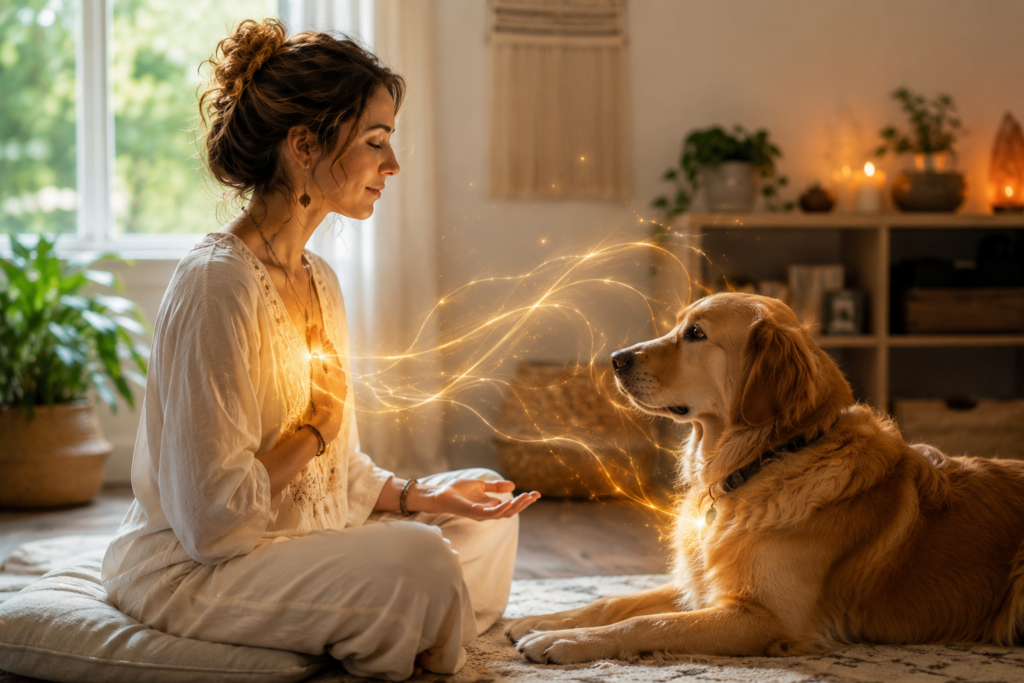
What Happens During an Animal Communication Session?
Every practitioner has their own approach, but an animal communication session generally follows a similar structure. The goal is to create a calm, respectful environment where intuitive information can be perceived and shared.
Before the Session
The practitioner usually asks for:
-A recent photo of the animal, with the eyes clearly visible if possible.
-The animal’s name, age, and species.
-A few questions or concerns you would like to explore.
-Sessions can take place remotely, which is often the preferred method because animals remain relaxed in their familiar environment.
During the Connection
The practitioner enters a state of focused calm and establishes an intuitive connection with the animal. Information may come through:
-Images
-Feelings or emotions
-Physical sensations
-Words or phrases
-Symbolic impressions
-Sudden intuitive insights
The communication is not forced. The practitioner simply receives what the animal chooses to express.
Sometimes the animal immediately addresses the owner’s main concern. Other times, it may communicate something entirely unexpected but deeply meaningful.
After the Session
The owner receives feedback about the messages perceived during the communication.
This may include:
-Emotional needs
-Sources of stress
-Preferences or dislikes
-Requests for environmental changes
-Information about relationships within the household
-Possible energetic imbalances
The session often provides greater understanding and helps strengthen the bond between owner and companion.
Final Thoughts
Whether you view animal communication as an intuitive practice, a spiritual experience, or simply an opportunity to reflect more deeply on your relationship with your companion, many owners describe it as profoundly meaningful.
Animals communicate constantly through their behavior, their emotions, and their presence. Some believe they also communicate on a more subtle energetic level.
Remaining open-minded while keeping realistic expectations allows you to explore this practice in a balanced way.
Ultimately, the strongest connection with your animal is built through patience, observation, respect, and love.
If you are curious about discovering what your companion may wish to express, an animal communication session can become a unique opportunity to strengthen your bond and better understand each other.
